Contents
Two conductors that look alike
Solid bare copper (BC) cable has a copper conductor all the way through. Copper-clad aluminium (CCA) cable has an aluminium core with a thin copper layer bonded to the outside. From the outside, and in a sales listing, they can look the same.
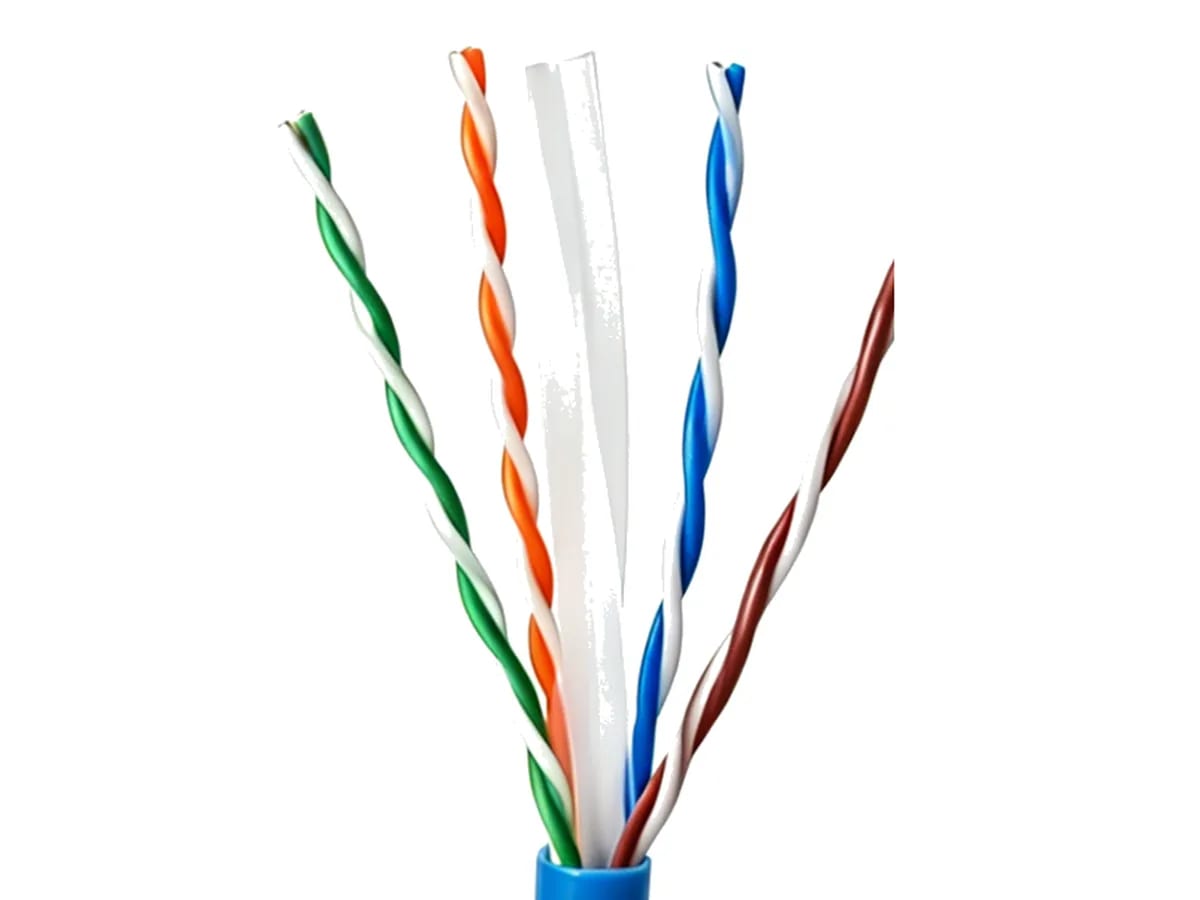
We supply both. This guide explains how they differ, what the cabling standards say and how to check what you are buying, so you can choose with the facts in front of you.
What changes when the core is aluminium
- Resistance. Aluminium conducts less well than copper. A CCA conductor has roughly 50–60% higher DC resistance than a solid copper conductor of the same diameter; the exact figure depends on how much copper is in the cladding.
- Weight. In a common CCA grade the conductor weighs about 40% of an equivalent copper one, which is why a box of CCA cable feels light.
- Strength. CCA conductors are more brittle. Repeated bending at a patch panel or faceplate can break them.
- Terminations. Where the aluminium core is exposed at a connector it oxidises over time, which can raise contact resistance.
| Property | Solid bare copper | Copper-clad aluminium |
|---|---|---|
| Conductor | Copper throughout | Aluminium core, thin copper outer layer |
| DC resistance, same size | Baseline | About 50–60% higher |
| Conductor weight | Baseline | About 40% of copper |
| Flex and terminations | Robust | More brittle; aluminium can oxidise at contacts |
| TIA / ISO category standards | Met when the cable is built and tested to the category | Not met: the standards call for copper conductors |
| Power over Ethernet | Suitable, within bundle and temperature limits | More heat and voltage drop; not recommended |
| Cost | Higher | Lower |
What the standards say
- Category standards. The TIA and ISO/IEC twisted-pair standards specify solid copper conductors. A CCA cable can be printed "Cat6", but it cannot meet the category specification. Industry bodies, including the UK Fibreoptic Industry Association, have stated that CCA is non-compliant with TIA, CENELEC and ISO/IEC cabling standards.
- DC resistance. The TIA limit for a horizontal cable conductor is 9.38 Ω per 100 m at 20 °C. A 24 AWG copper conductor measures around 8.4 Ω per 100 m; the same size in CCA works out at roughly 12.5 Ω, above the limit.
- United States. UL 444, the safety standard for communications cable, requires copper or metal-coated copper conductors and allows CCA only as the centre conductor of coaxial cable. CCA twisted-pair cable therefore cannot carry a valid UL or ETL listing as CM, CMR or CMP cable, and does not qualify where the electrical code calls for listed communications cable, for example inside walls and ceilings.
- European Union. The Construction Products Regulation (EN 50575) classifies cables by reaction to fire, with Euroclasses such as Cca-s1,d1,a1. It does not regulate conductor material. The fire class "Cca" has nothing to do with copper-clad aluminium.
DC resistance of one conductor, per 100 m
Approximate values at 20 °C for a 24 AWG conductor. The CCA figure is calculated from its conductivity (about 67% of copper).
Power over Ethernet
PoE sends power along the same pairs as data. Higher conductor resistance means more of that power is lost as heat in the cable and less reaches the camera or access point. With higher-power PoE (IEEE 802.3bt, up to 90 W at the switch) and in large bundles, the extra heat matters.
TIA's current guidance recommends Category 6A or better for PoE, an ambient temperature no higher than 45 °C and splitting large bundles. For PoE, choose copper. See Cat5e, Cat6 or Cat6A for the category side of the decision.
How to check a sample
- Ask for it in writing. The datasheet, quotation and invoice should state the conductor material: "solid bare copper" or "CCA".
- Scrape a conductor. Remove the insulation and scrape the surface with a knife. Copper stays copper-coloured; CCA shows silver-white metal underneath.
- Weigh the box. A CCA box is noticeably lighter than copper of the same length and size. This is only a hint, because weight can vary for other reasons.
- Measure DC resistance. This is the most reliable check. Measure one conductor over a known length and compare it with about 9.38 Ω per 100 m. A test report from the supplier should show the same.
Two popular tests do not work. A magnet cannot tell copper from aluminium, because neither is magnetic; it only finds copper-clad steel. A flame test is not a reliable way to identify the conductor.
When CCA can make sense, and when to choose copper
CCA is widely sold because it costs less. Some buyers choose it for short indoor runs that carry data only, in projects where no standards certification or code listing is required and the budget comes first. That is a market practice, not something the standards allow, so the choice should be made knowingly.
Choose solid copper when any of these apply:
- the cabling must be certified to a category standard, or carry a warranty that requires it;
- the cable will carry PoE, especially higher-power PoE or in large bundles;
- the cable is going into a building in the United States, or anywhere a listed communications cable is required;
- runs approach the 90 m horizontal limit;
- the installation is meant to last.
How we supply it
Our network cables are offered with either conductor. The quotation states the conductor material, size and length for every line, so there is no doubt about what will be shipped. If you need a measured DC-resistance figure, ask for it with your enquiry.
Products in this guide
References
- Fluke Networks, application note on copper-clad aluminium cables (2014), and "CCA: not worth the savings or the risk" (2017).
- Communications Cable and Connectivity Association (CCCA), statements on CCA conductors and UL 444 (2011, 2012).
- Intertek, UL 444 communication cables standard update (effective 2015).
- Cabling Installation & Maintenance, report on the Fibreoptic Industry Association advisory note on CCA (2011).
- Siemon, summary of ANSI/TIA-568.2-E (2024).
- CommScope, white paper on the EU Construction Products Regulation (2017, revised 2018).
- Kanthal, copper-clad aluminium 15% wire datasheet.