Contents
How to read the code
ISO/IEC 11801 writes the construction as two parts separated by a slash, followed by TP for twisted pair. Before the slash is the overall screen around all four pairs; after the slash is the screen around each individual pair.
- U: unscreened
- F: foil, usually aluminium
- S: braid, a woven screen of fine wires
So SF/UTP means an overall braid and an overall foil around four pairs that are not individually screened, and S/FTP means an overall braid with foil around each pair.
U/UTP
- Four unscreened pairs
- Jacket
F/UTP
- Four unscreened pairs
- Overall foil
- Jacket
SF/UTP
- Four unscreened pairs
- Overall foil and braid
- Jacket
S/FTP
- Foil around each pair
- Overall braid
- Jacket
| Code | Overall screen | Each pair | Older names |
|---|---|---|---|
| U/UTP | None | None | UTP |
| F/UTP | Foil | None | FTP |
| SF/UTP | Braid + foil | None | SFTP, S-FTP |
| U/FTP | None | Foil | STP (sometimes) |
| F/FTP | Foil | Foil | — |
| S/FTP | Braid | Foil | STP, PiMF |
The older names are not used consistently: "STP" has been used for S/FTP, S/UTP and SF/UTP. When you order, give the full code.
What a screen does
- Keeps outside noise out. Motors, variable-frequency drives, power cables and radio transmitters create electromagnetic interference. A screen stops much of it reaching the pairs.
- Keeps the cable's own signal in. A screen reduces what the cable radiates into neighbouring cables and equipment.
- Pair foils reduce crosstalk inside the cable. In xx/FTP constructions each pair is wrapped, which isolates the pairs from one another.
Foil and braid work best at different frequencies. Foil gives full coverage and is effective at high frequencies. Braid, which typically covers 75–85% of the surface, is stronger at low frequencies and is mechanically tougher. That is why SF/UTP and S/FTP combine the two.
A screen only works if it is connected
A shielded cable is one part of a shielded system. For the screen to do its job:
- Every component must be shielded. Use shielded jacks, shielded patch panels and shielded patch cords. A single unshielded link breaks the screen.
- The screen must be bonded to earth. The cable screen connects through the shielded jack to the patch panel, and the panel connects to the rack's bonding bar, following the TIA-607 series or EN 50310. A shielded patch cord carries the bond to the equipment at the work area.
- Potentials should be equal. Manufacturers recommend keeping the voltage difference between the screen and equipment earth below about 1 V rms to avoid ground-loop noise.
Racks and patch panels should be bonded in unshielded systems too; the difference is that a U/UTP cable has no screen to connect.
Trade-offs
Shielded cable is usually thicker and stiffer than unshielded cable, takes longer to terminate and costs more, once the shielded connectors and the bonding work are included. Check the outside diameter and minimum bend radius on the datasheet when planning trays and conduits.
Which one to choose
| Situation | Usual choice |
|---|---|
| Offices, homes and shops with no heavy electrical equipment nearby | U/UTP |
| Near motors, drives, welding, lift machinery or power distribution | F/UTP or SF/UTP |
| Factories and plants with strong, mixed-frequency interference | SF/UTP or S/FTP |
| Hospitals, broadcast, laboratories and other sensitive sites | Shielded, to the site's specification |
| Markets where shielded cabling is the norm, such as Germany, Austria and Switzerland | S/FTP is common |
Two misconceptions to avoid. "Shielded is always better" holds only if the whole channel is shielded and properly bonded; in an ordinary office, well-made U/UTP rejects most noise through pair twisting alone. "Cat7 is the next step after Cat6A" is not right either: Category 7 and 7A are ISO classes that TIA does not recognise, built as fully shielded S/FTP, and many products sold online as "Cat7" patch cords follow no standard.
What we supply
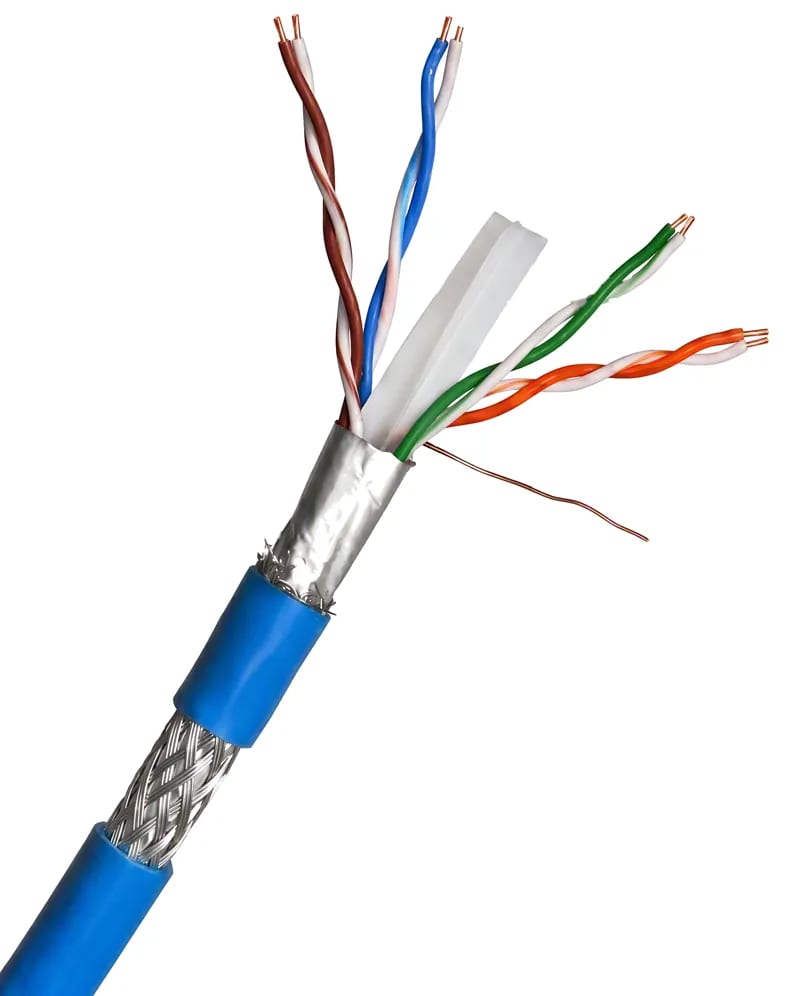
Our Cat6 SF/UTP has an overall braid and foil around four unshielded pairs; the manufacturer lists it as "CAT6 SFTP", and the ISO code is SF/UTP. Cat5e is available with an overall foil, and unshielded U/UTP is available in Cat5e, Cat6 and Cat6A. Tell us the environment and the code you need; the quotation states the construction for each line.
Products in this guide
References
- Telegärtner, "Copper cable design" (2025): ISO/IEC 11801-1 naming.
- Fluke Networks knowledge base, "Acronyms for balanced cables" (2014).
- Belden, "STP, UTP, FTP cable and when to use them" (2015, updated 2019), and "Effective shielding in a cabling system" (2019).
- CommScope, white paper on bonding and grounding copper cabling systems (2017).
- Design World, "How do the three types of shielded cables work?" (2023).
- Cabling Installation & Maintenance, "What ever happened to Category 7?" (2019).