Contents
- Chinese wire codes at a glance
- What Chinese wire letter codes mean
- The five codes side by side
- BV and BVR: fixed building wire
- RVV, RVS and RVB: flexible connection wires
- RVV — sheathed multi-core
- RVS — twisted pair
- RVB — flat parallel twin
- Voltage ratings you will see
- How to read a quote line (step by step)
- How to write the size on an enquiry
- Check what you are comparing
- What does BV mean on Chinese wire?
- What is the difference between BV and BVR?
- What does RVV mean?
- RVS vs RVB — what is the difference?
- Are Chinese wire sizes in AWG or mm²?
- What voltage ratings appear on BV, BVR and RVV?
- How should I write a Chinese wire enquiry to Sorint?
Chinese wire codes at a glance
Quick answer: BV and BVR are building-wire designations; RVV denotes a PVC-sheathed flexible multi-core wire, RVS a twisted pair and RVB a flat parallel pair. The code describes a family, not the complete specification. Confirm conductor material and construction, nominal mm², rated voltage and the applicable standard for the exact order.
What Chinese wire letter codes mean
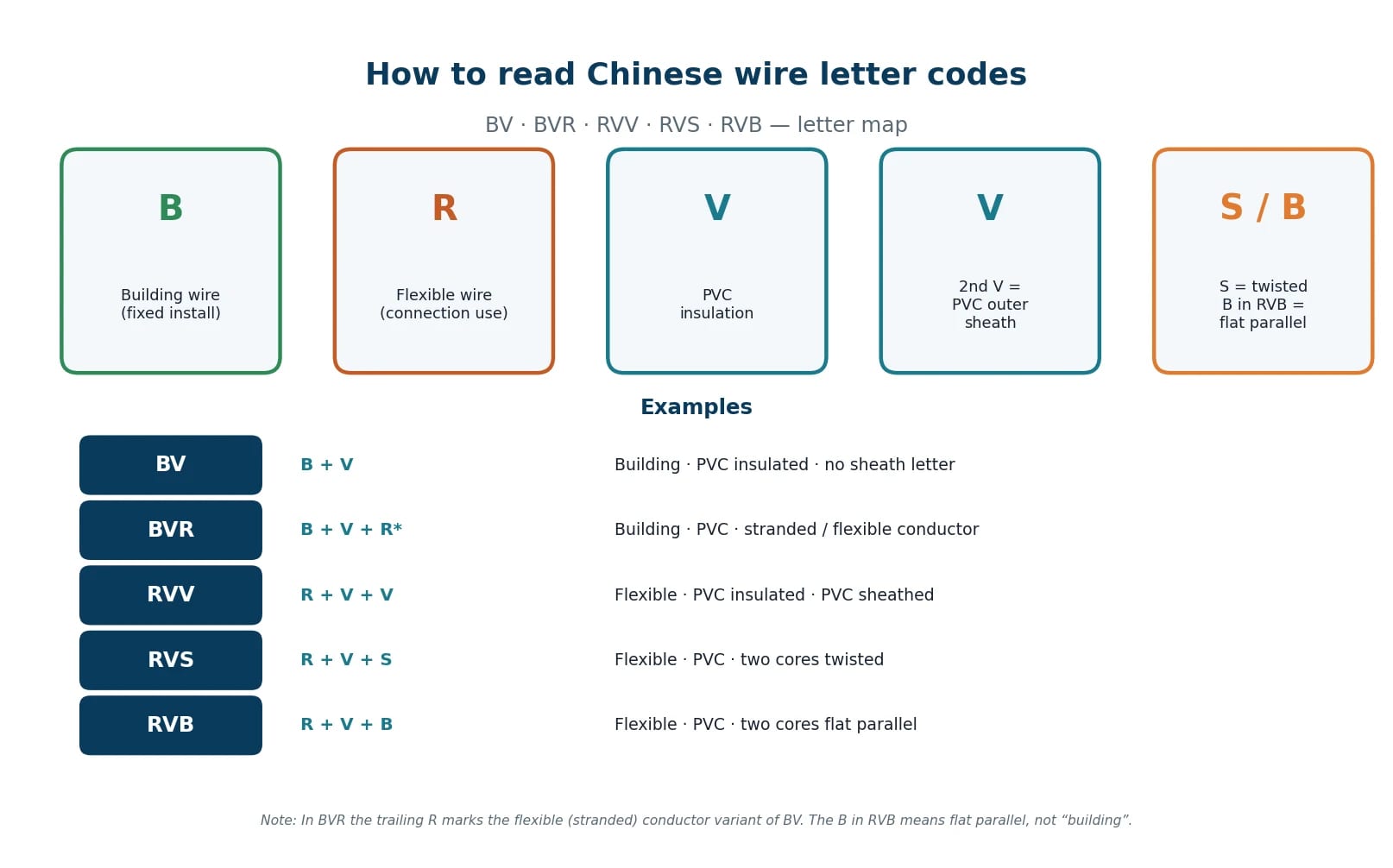
Chinese wire type codes are built from a few recurring letters. The full type definitions live in Chinese national standards (for example the GB/T series for PVC-insulated wires and cables). For buying, you mainly need the letter map below.
| Letter | Usual meaning in these products |
|---|---|
| B | Building wire (布电线), for fixed installation |
| R | Flexible connection wire (软线 / 连接用软电线) |
| V | PVC insulation |
| Second V | PVC outer sheath |
| S | Twisted cores |
| B (in RVB) | Parallel flat (not the same "B" as BV) |
So BV is a PVC-insulated building wire with no outer sheath letters, and RVV is a flexible multi-core wire with both PVC insulation and a PVC sheath. In BVR, the trailing R marks the flexible (stranded) conductor variant of BV — not the same role as the leading R in RVV/RVS/RVB.
The five codes side by side
| Code | Construction (typical) | Conductor | Cores | Usual use |
|---|---|---|---|---|
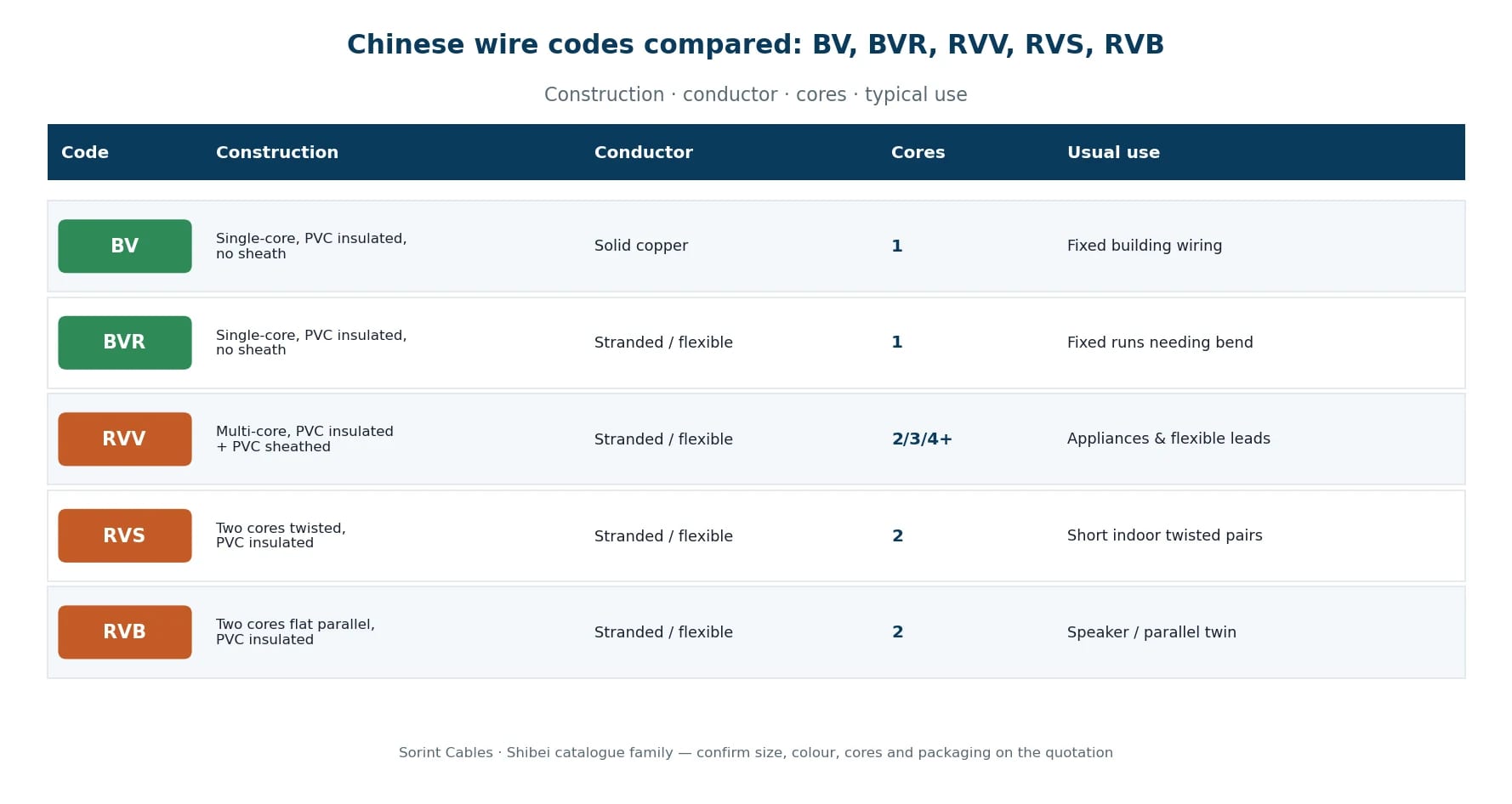
| BV | Single-core, PVC insulated, no sheath | Solid copper | 1 | Fixed building wiring |
| BVR | Single-core, PVC insulated, no sheath | Stranded / flexible copper | 1 | Fixed runs that need more bendability than BV |
| RVV | Multi-core, PVC insulated and PVC sheathed | Stranded / flexible copper | 2 / 3 / 4 (common) | Appliances, equipment and short flexible connections |
| RVS | Two cores twisted together, PVC insulated | Stranded / flexible copper | 2 | Lighting switches, bells, short indoor twisted pairs |
| RVB | Two cores in parallel (flat), PVC insulated | Stranded / flexible copper | 2 | Speaker / parallel twin runs |
We list Shibei BV, BVR, RVV, RVS and RVB in the catalogue. Size, colour, core count and packaging are confirmed on the quotation.
BV and BVR: fixed building wire
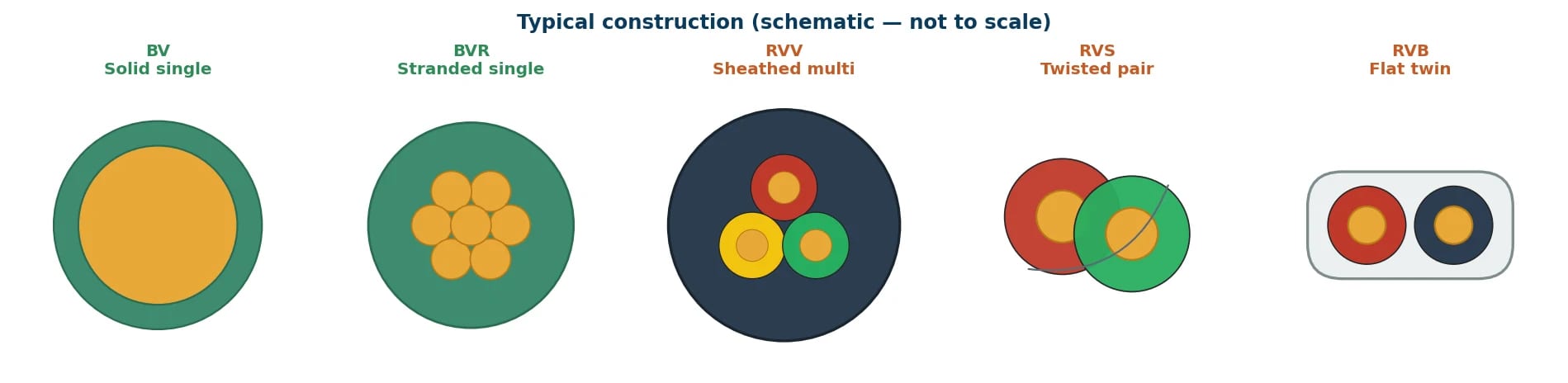
The BV examples shown here are solid single-core building wire; the model name alone is not proof of every SKU's conductor construction. BVR is the flexible (stranded) version of the same family. Both are PVC-insulated and usually sold without an outer sheath letter in the type code.
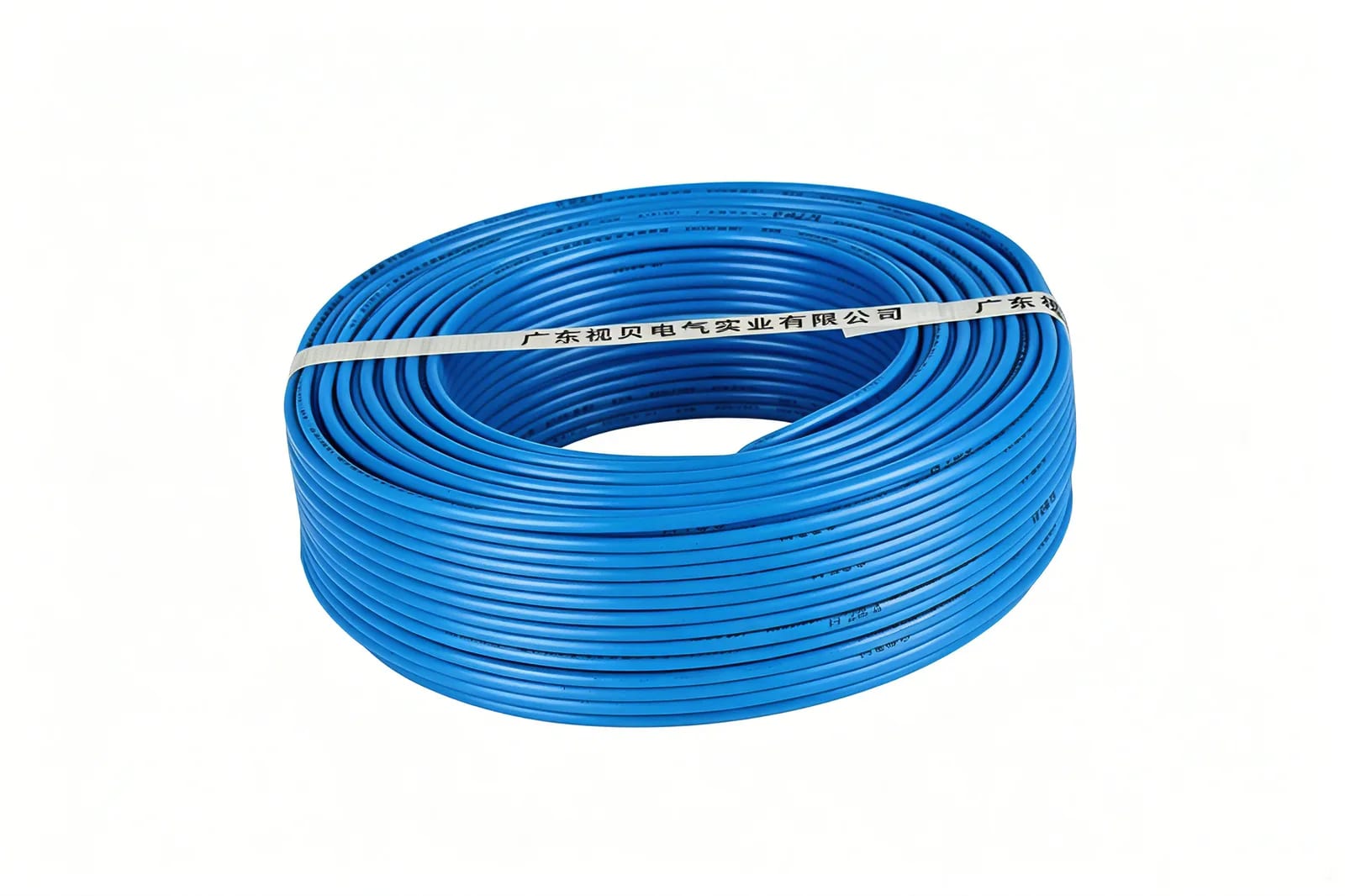
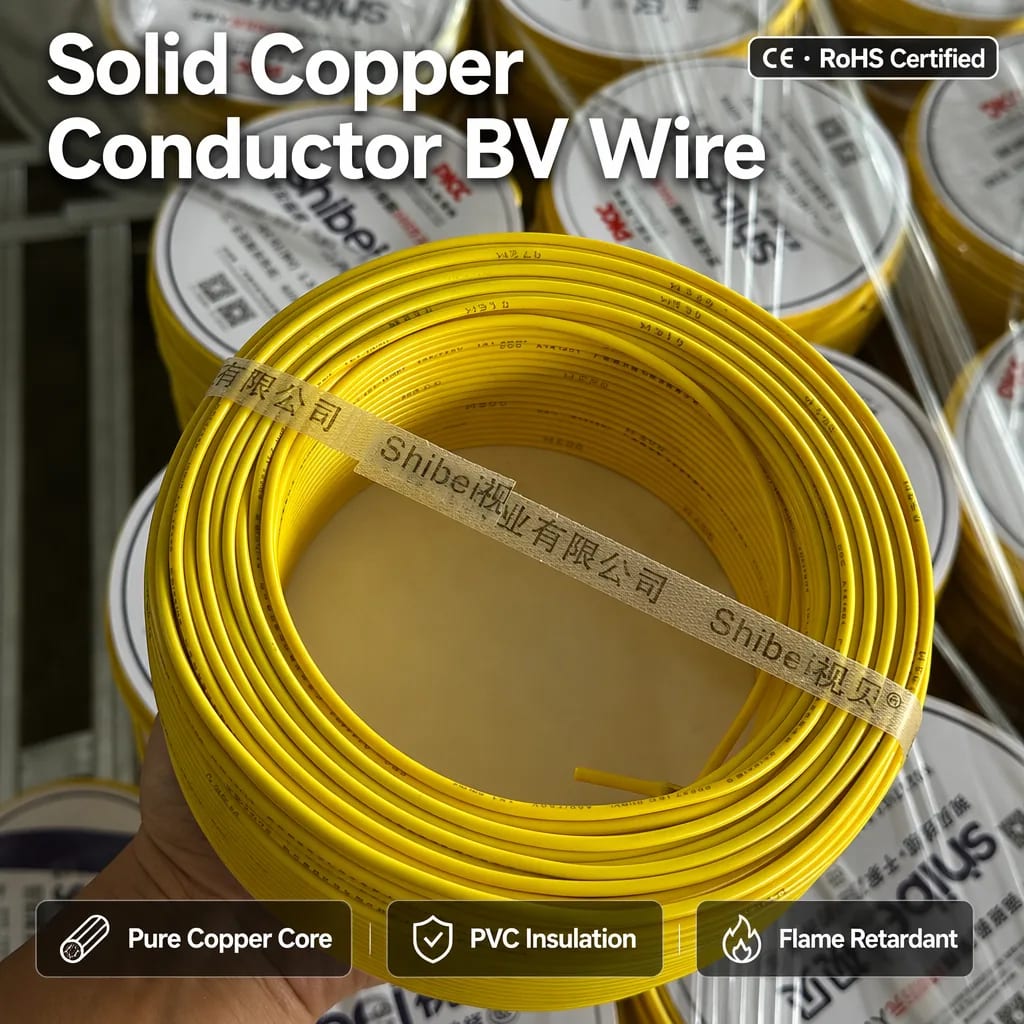
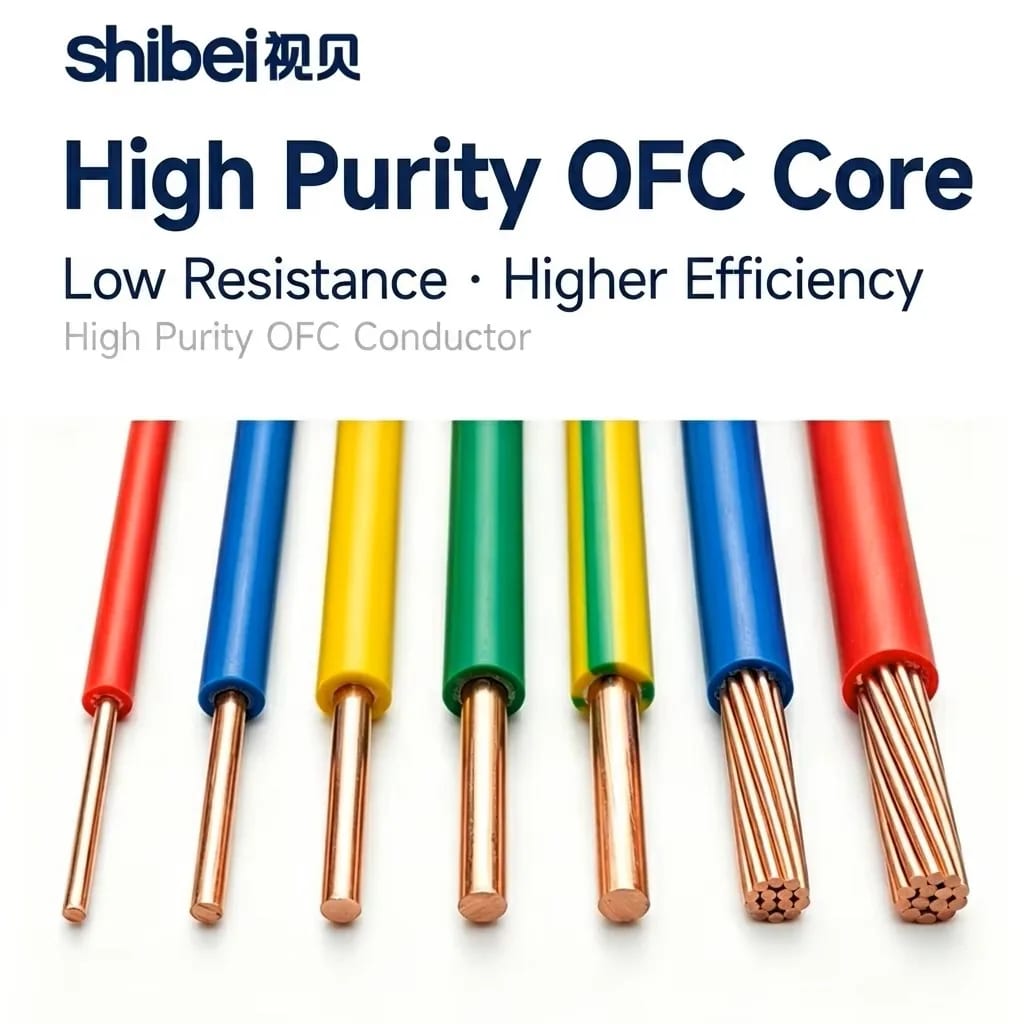
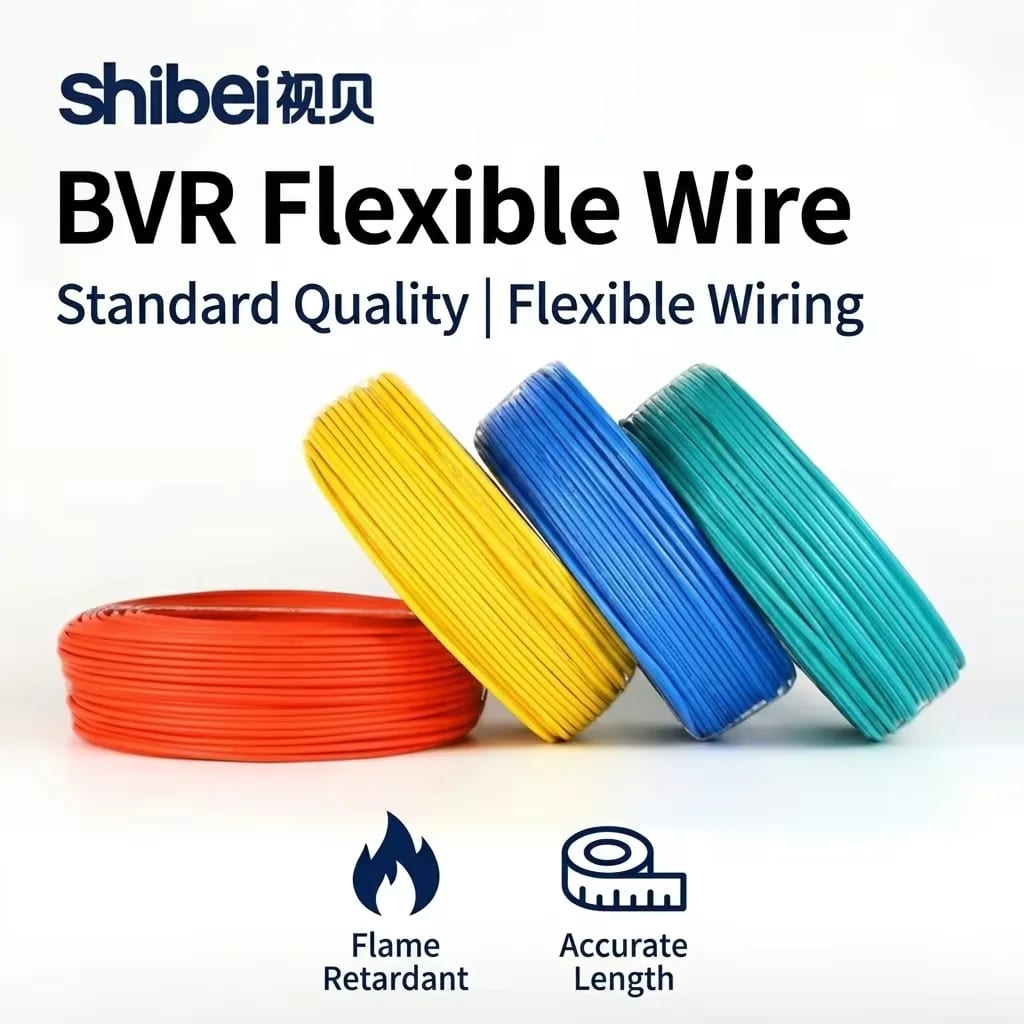
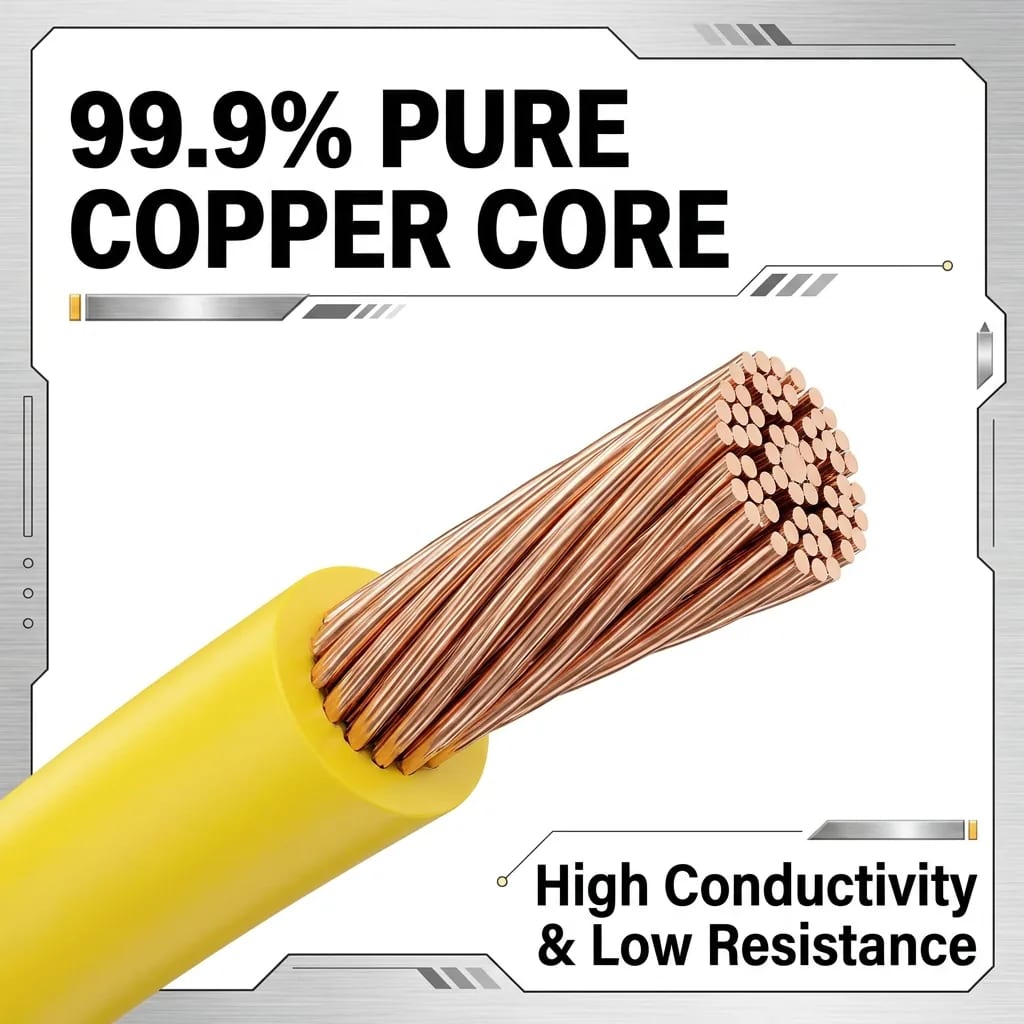
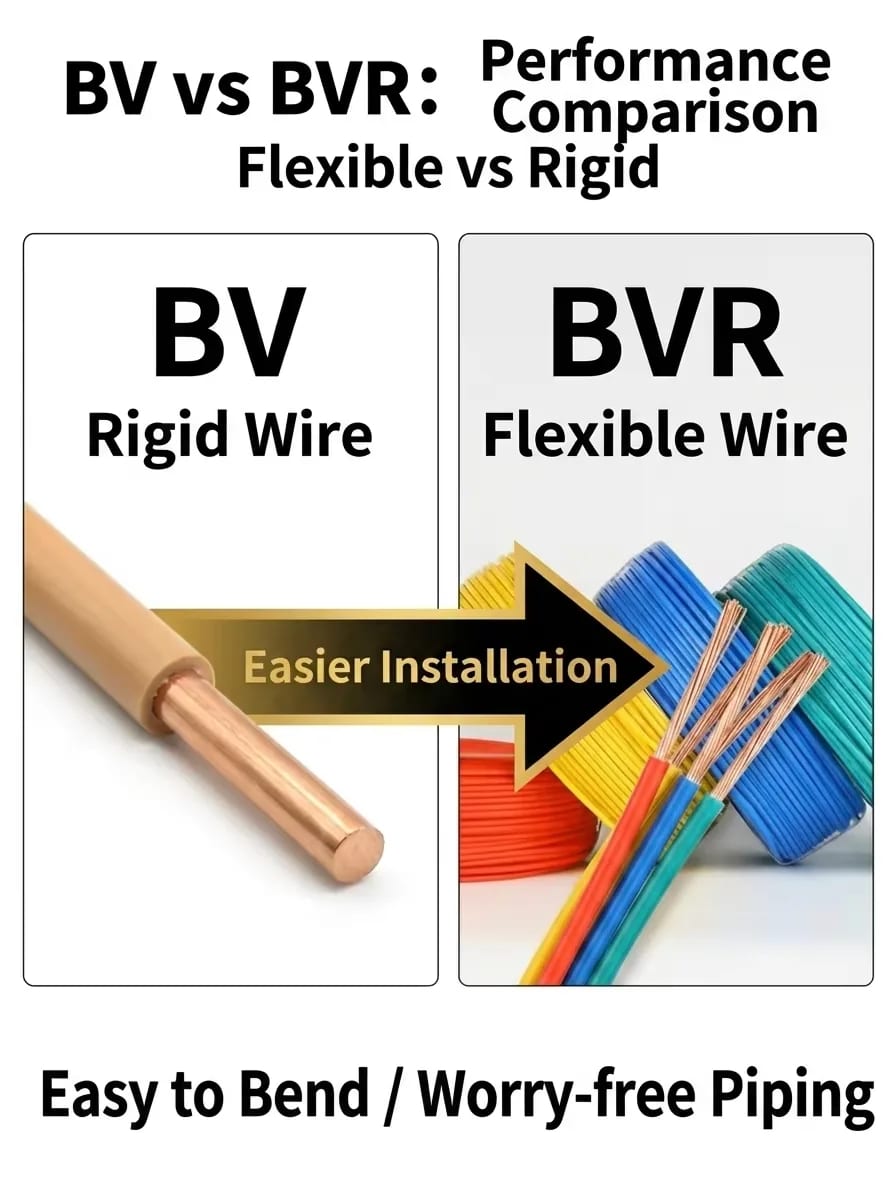
- Choose BV when the run is fixed, bends are few and the installation expects a solid conductor.
- Choose BVR when the same circuit needs a more flexible single core — tight trays, frequent dressing, or terminations that prefer stranded wire.
- Our linked BV record states 450/750 V. Do not infer the BVR rating from BV: confirm voltage, conductor construction and cross-section for the exact SKU on the datasheet and quotation.
Don't swap them blindly. Solid and stranded conductors terminate differently, and some project specs name one type only.
Catalogue links: BV · BVR · family BV / BVR building wire.
RVV, RVS and RVB: flexible connection wires
These three start with R because they are flexible connection wires, not the fixed building-wire family.
RVV — sheathed multi-core
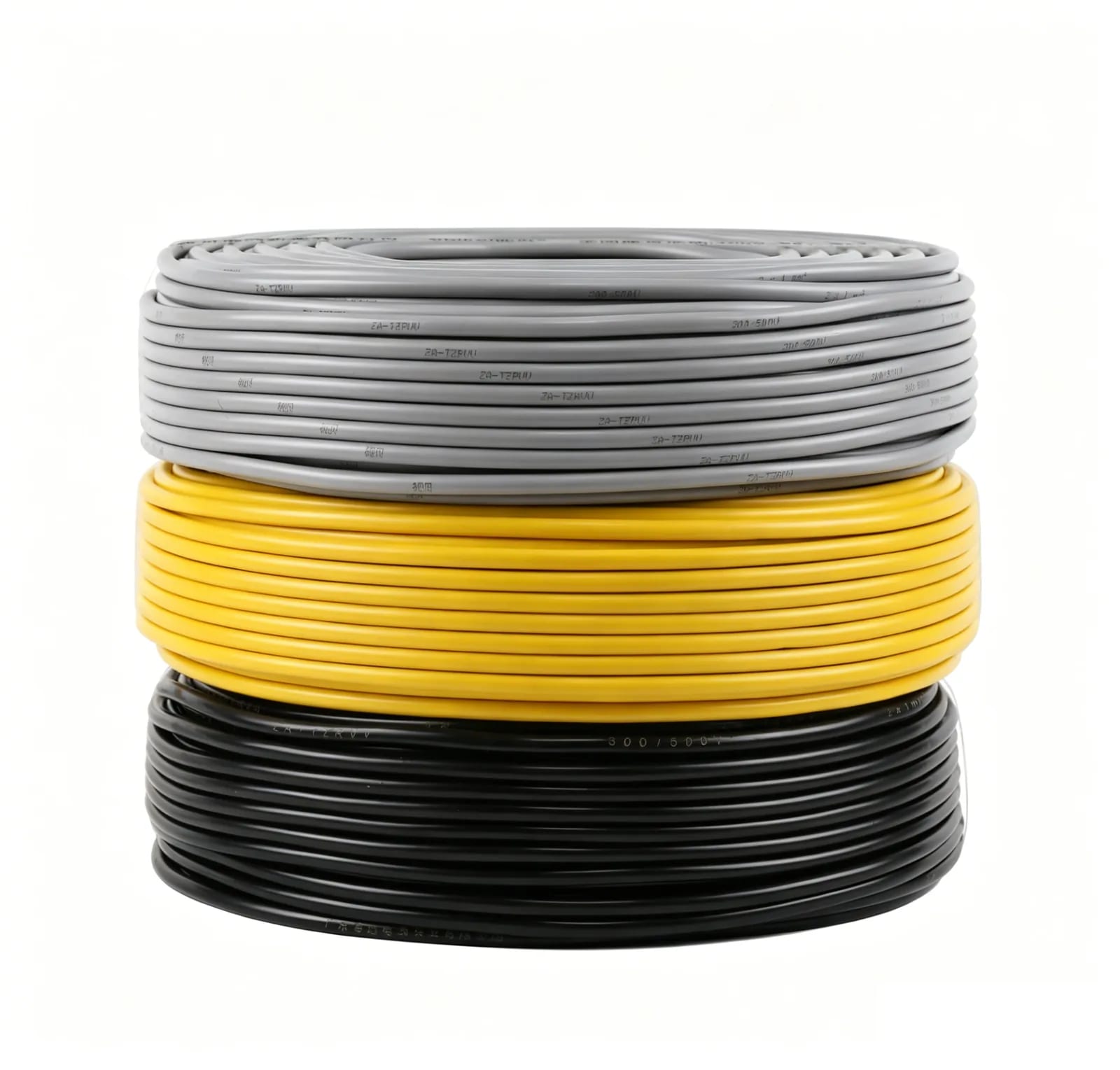
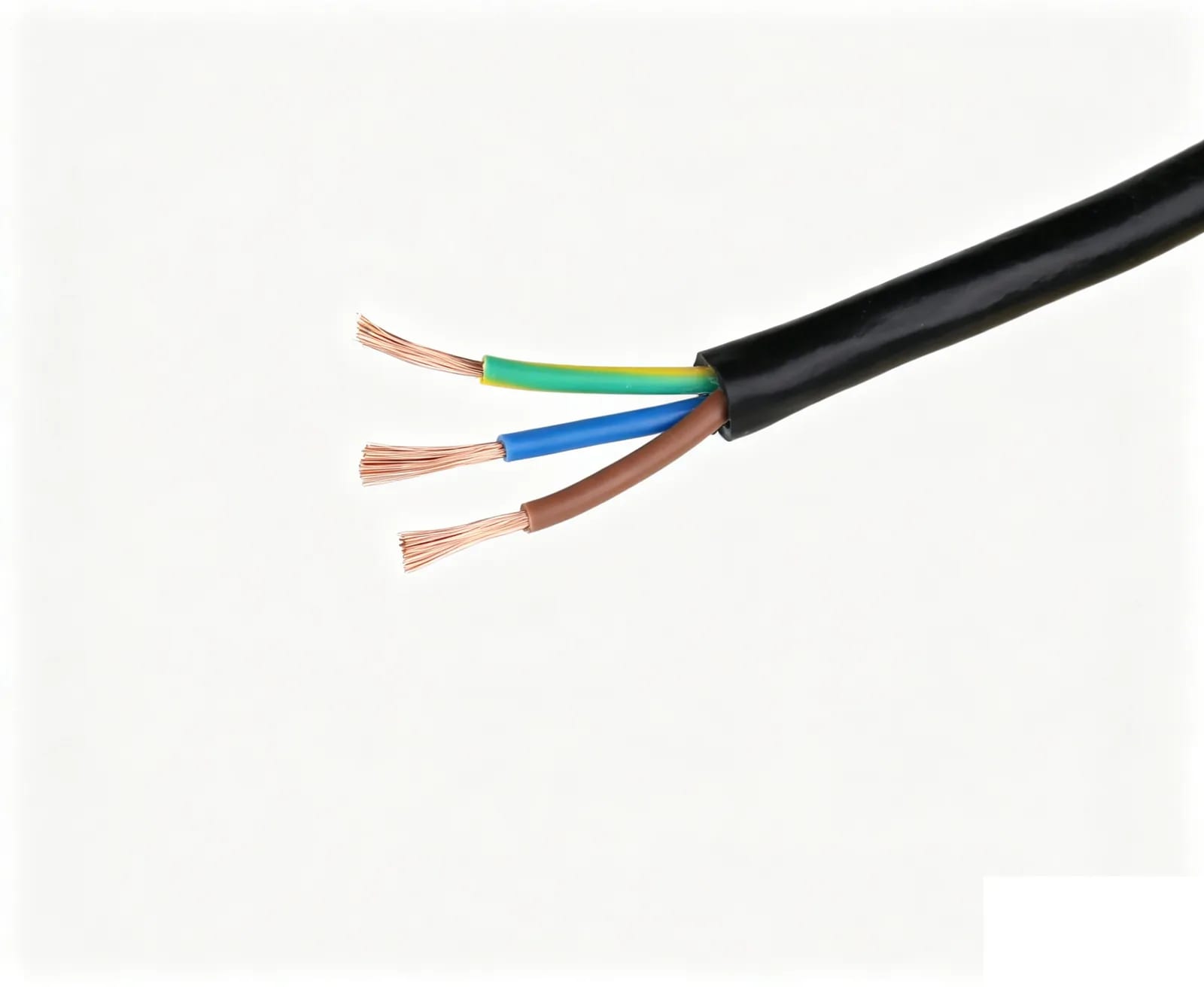
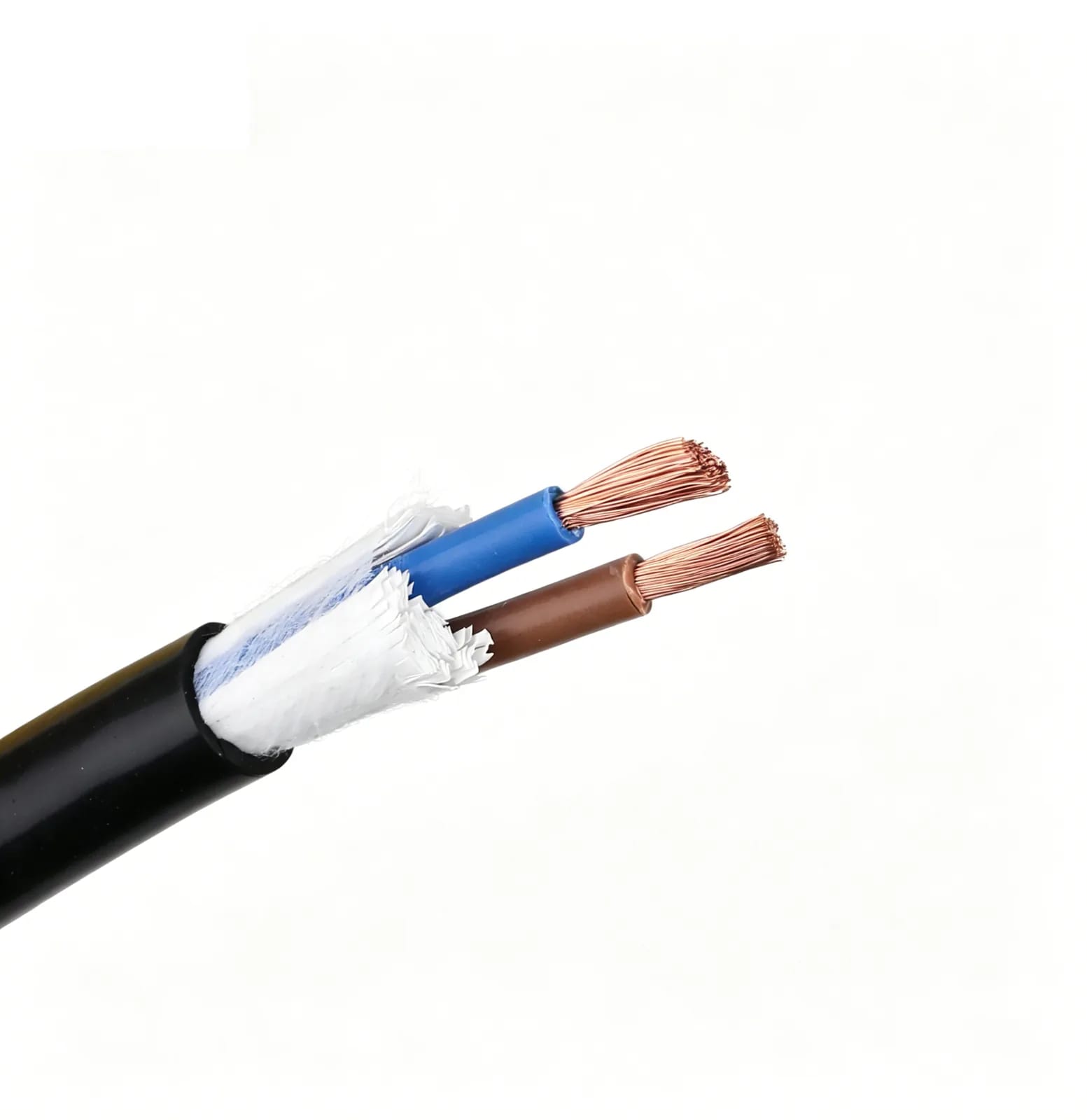
RVV carries a PVC sheath over the insulated cores. You usually specify core count × cross-section, for example 3×1.5 mm². It is the usual choice for appliance leads and short multi-core flexible runs. Family page: RVV flexible sheathed cable.
RVS — twisted pair
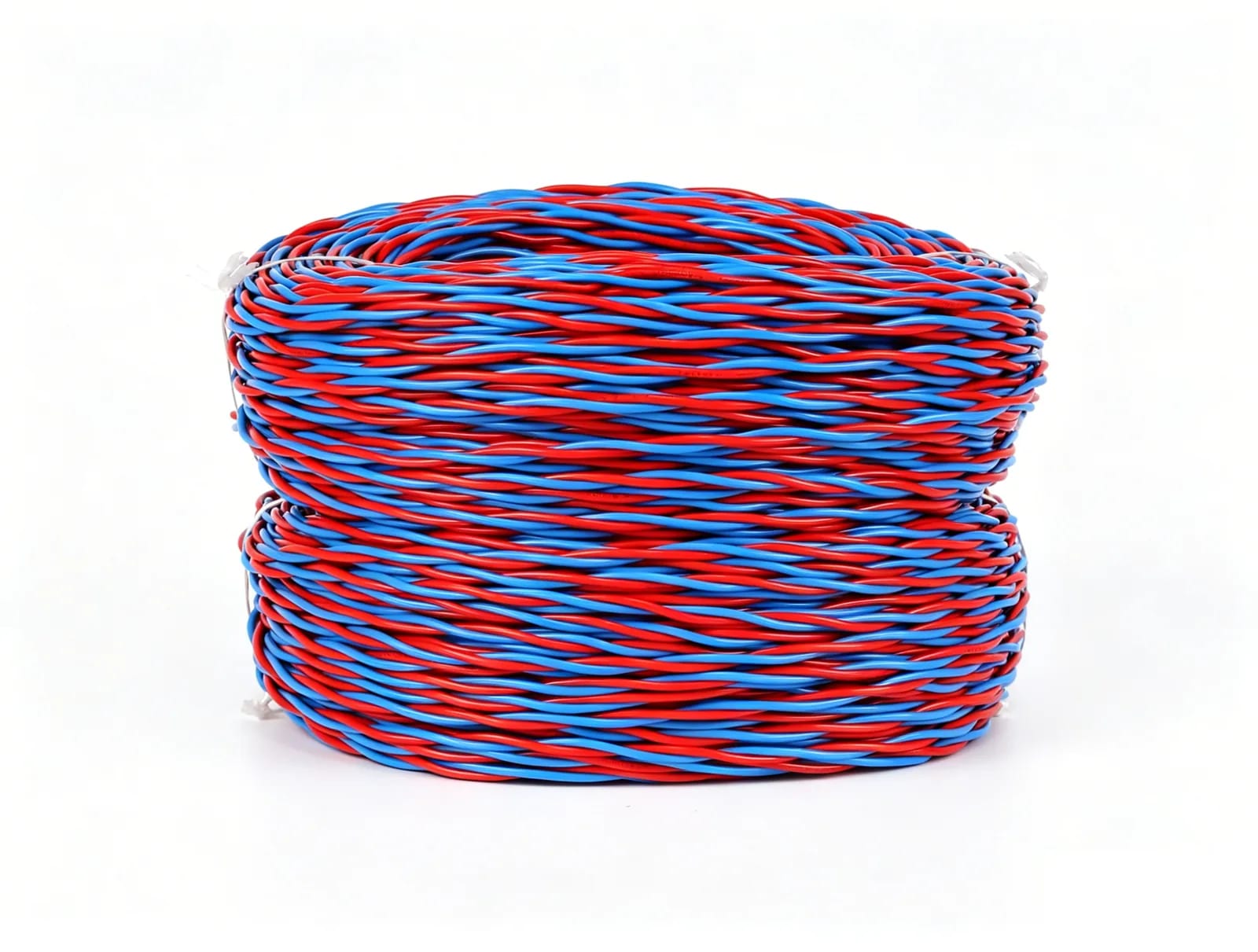
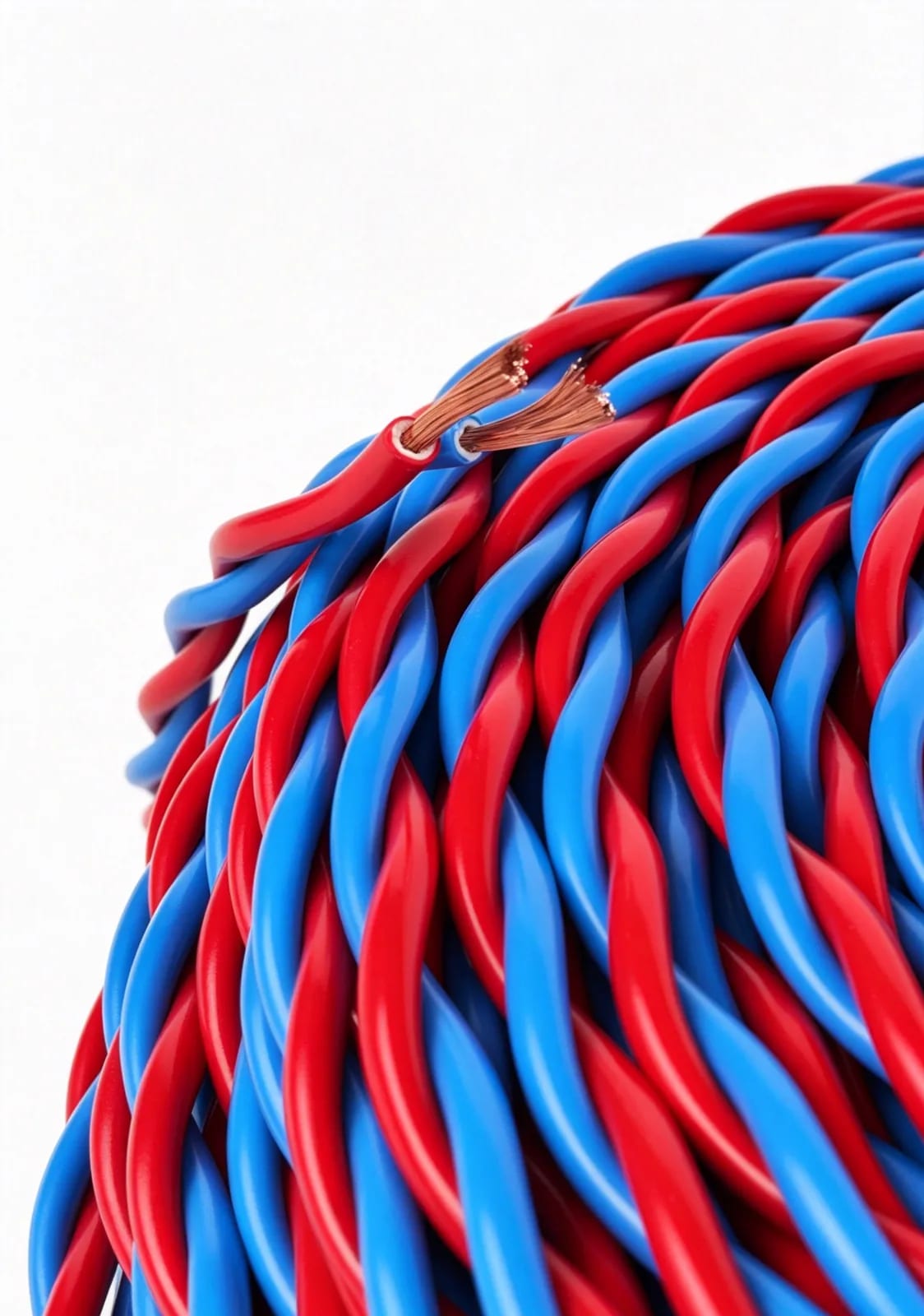
RVS is a two-core twisted pair without a full outer sheath in the type name. It is common for short indoor signalling and lighting-related pairs. Typical rated voltage on our RVS listing is 300 V; confirm on the quote. Family page: RVS twisted wire.
RVB — flat parallel twin
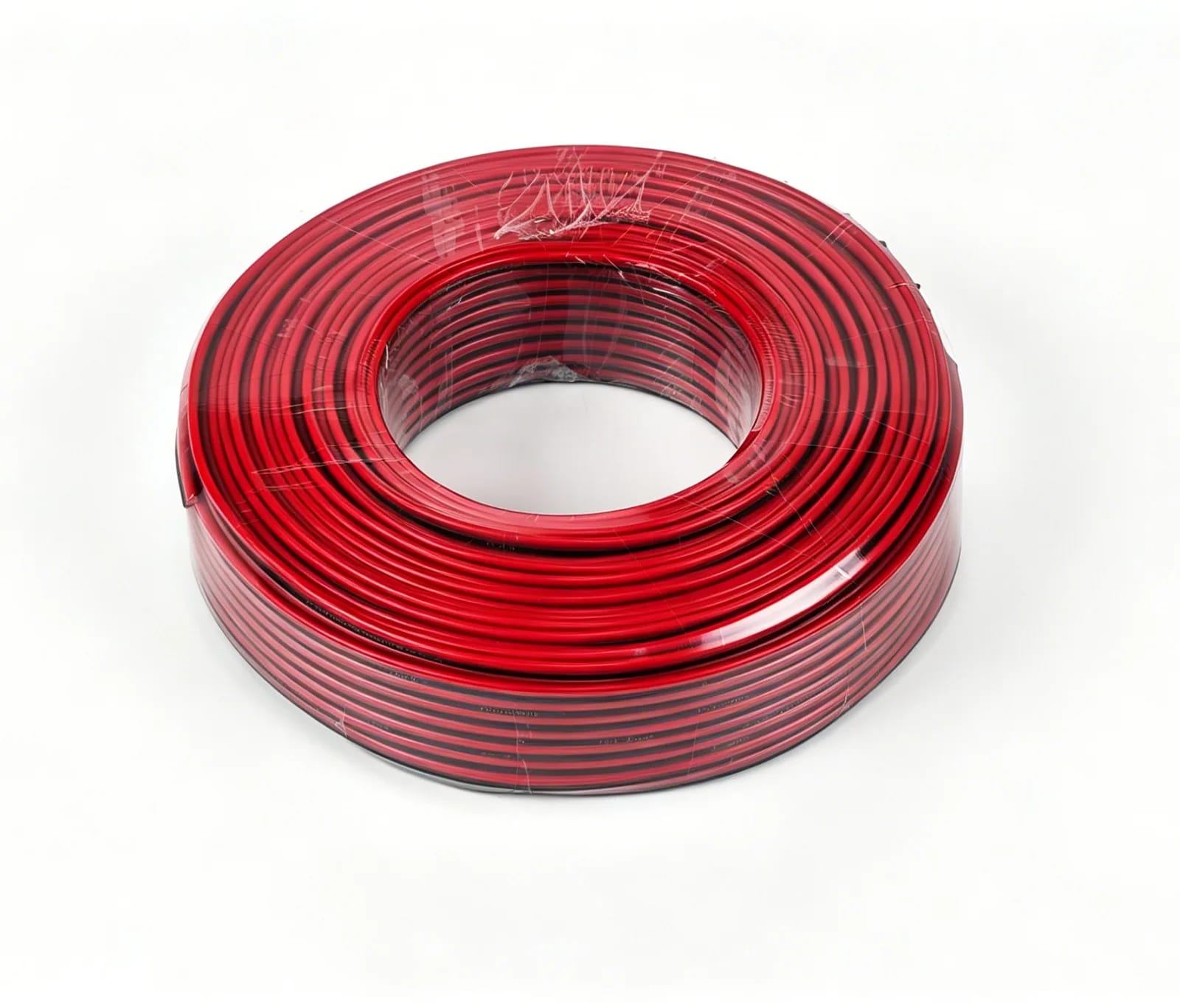
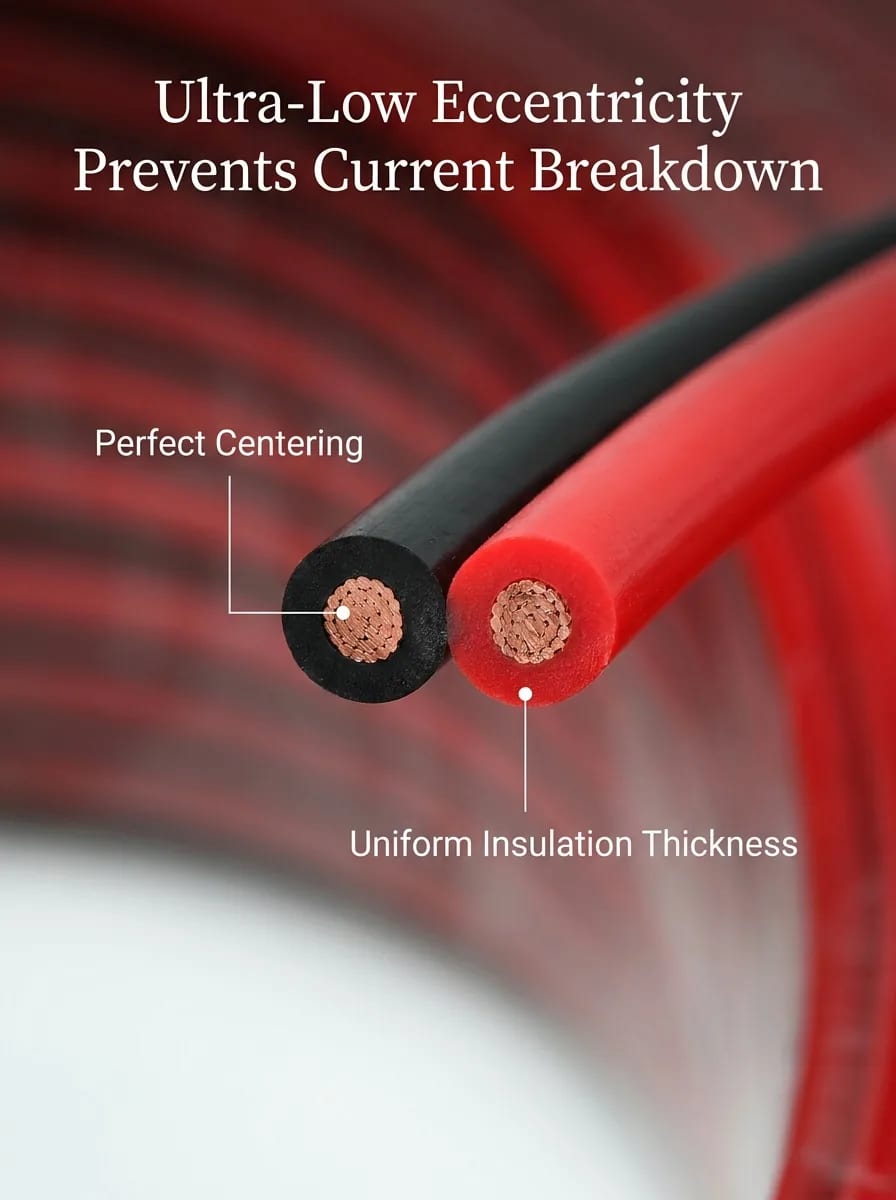
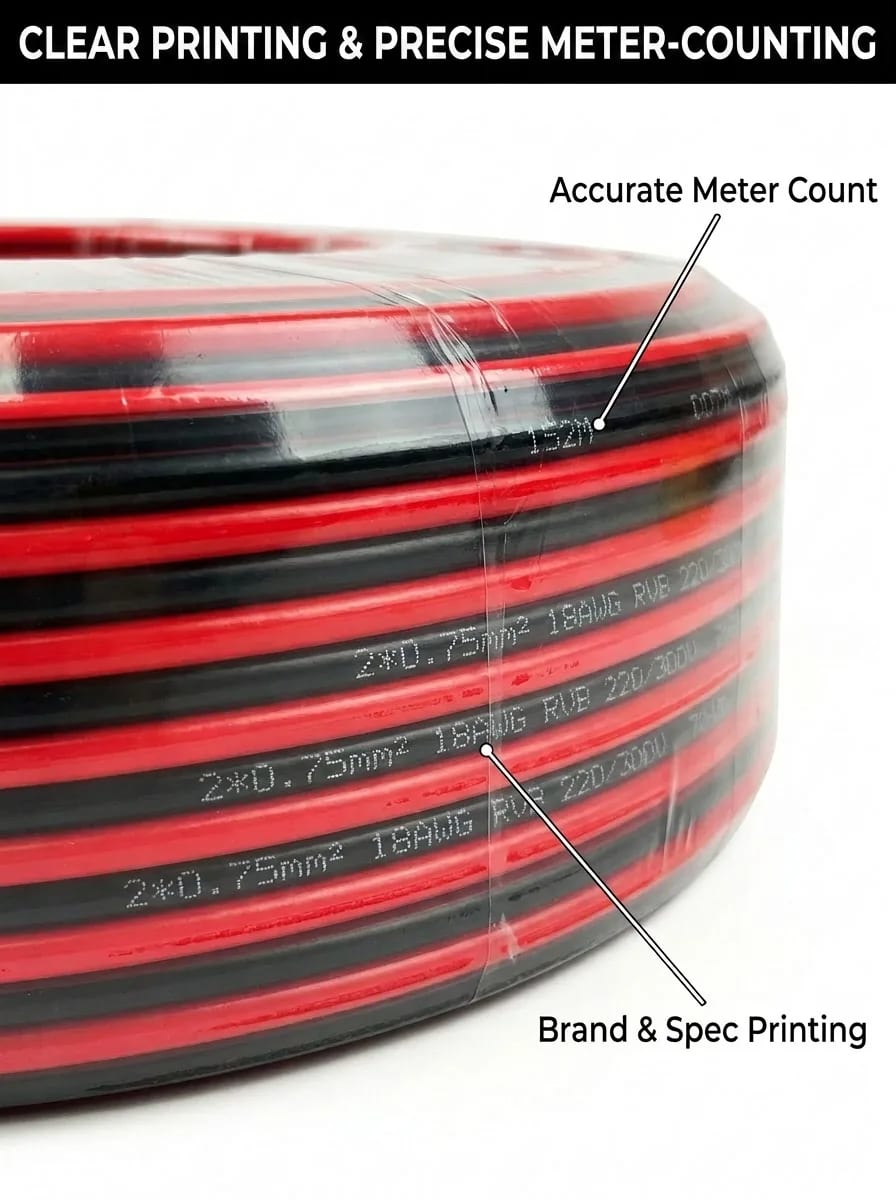
RVB is a flat two-core parallel wire, often used as speaker wire or other parallel twin runs. It is not the same letter family as BV building wire even though both contain a "B". Family page: RVB speaker wire.
If a quotation only says "flexible PVC cable", ask whether it is RVV (sheathed multi-core), RVS (twisted pair) or RVB (flat twin). The form factor and sheath change how the cable is pulled, terminated and priced.
Voltage ratings you will see
Two figures appear often on Chinese PVC wires:
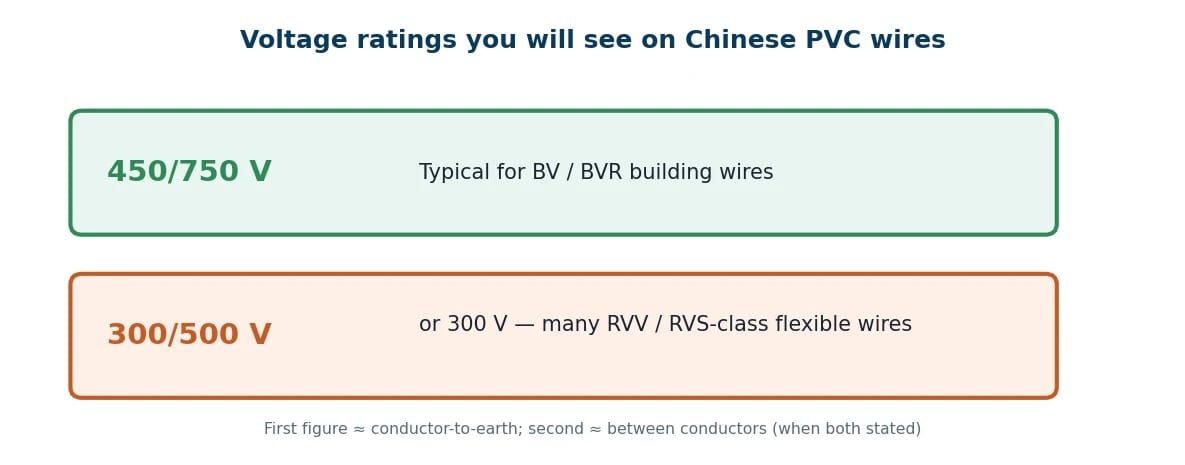
| Rating | Where it usually shows up |
|---|---|
| 450/750 V | Building wires such as BV / BVR |
| 300/500 V or 300 V | Many flexible connection wires (RVV / RVS class) |
The first number is the voltage between a conductor and earth (or metal covering); the second is between conductors, when both are stated. Match the rating to the installation, not only the letter code. For an order, use the rated voltage and cross-section on the exact product datasheet.
How to read a quote line (step by step)
These Chinese electrical-wire listings specify nominal conductor cross-section in mm². If your project uses AWG, agree the conversion and construction on the quotation. A typical enquiry or quote line looks like:
RVV 3×1.5 mm², 100 m coils, black
| Frame | Highlight | Meaning for the buyer |
|---|---|---|
| 0 | Full line | Example enquiry: RVV 3×1.5 mm², 100 m coils, black |
| 1 | RVV | Type code — flexible, PVC insulated + PVC sheathed |
| 2 | 3×1.5 | Core count × cross-section |
| 3 | mm² | Metric size — Use the agreed metric cross-section |
| 4 | 100 m coils | Length / packaging |
| 5 | black | Colour |
How to write the size on an enquiry
A clear enquiry line includes:
- Type code (BV, BVR, RVV, RVS or RVB)
- Cross-section in mm² (and core count for multi-core, e.g. RVV 3×1.5)
- Rated voltage if it matters to the project
- Colour, length and packaging (100 m coil is common on our electrical listings; confirm)
- Destination and any marking or OEM needs
Example: RVV 3×1.5 mm², PVC sheath, 100 m coils, black, for appliance connection, destination EU warehouse.
Check what you are comparing
Line these up when comparing quotations:
- Exact type code: BV vs BVR, or RVV vs RVS vs RVB
- Conductor: solid or stranded; copper grade as stated on the quote
- Cross-section in mm² and, for multi-core, the core count
- Rated voltage (450/750 V vs 300/500 V class)
- Sheath present or not (RVV has a sheath letter; BV / BVR typically do not)
- Length and packaging: 100 m coil, other coil lengths, or custom
Ask for the type code, conductor, size, voltage class and length to be stated on every quotation line. If a Chinese code is missing from a supplier quote, ask them to write it before you compare price alone.
For network-cable conductor and category choices on the same site, see CCA or solid copper? and Cat5e, Cat6 or Cat6A?.
What does BV mean on Chinese wire?
BV is a PVC-insulated building wire for fixed installation, typically a solid copper single core without an outer sheath letter in the type code. It is commonly rated 450/750 V; confirm the rating on the datasheet for the size you order.
What is the difference between BV and BVR?
Both are PVC-insulated building wires. In the examples shown here, BV has a solid conductor and BVR denotes a stranded / flexible variant. Confirm the exact construction on the supplier datasheet. Choose BVR when the run needs more bendability; do not swap them if the project specification names only one type.
What does RVV mean?
RVV is a flexible multi-core connection wire with PVC insulation and a PVC outer sheath. You normally specify it as cores × mm² (for example RVV 3×1.5). It is widely used for appliance leads and short flexible equipment connections.
RVS vs RVB — what is the difference?
RVS is a twisted two-core flexible PVC wire. RVB is a flat parallel two-core flexible PVC wire (often used as speaker / parallel twin). Neither is the same as sheathed multi-core RVV, and the B in RVB does not mean “building” like the B in BV.
Are Chinese wire sizes in AWG or mm²?
These Chinese electrical-wire listings specify nominal conductor cross-section in mm². If your project uses AWG, agree the conversion and construction on the quotation. Write the cross-section in mm² on the enquiry (and core count for multi-core). For AWG requests, state both the requested gauge and the agreed metric cross-section.
What voltage ratings appear on BV, BVR and RVV?
BV / BVR building wires are commonly 450/750 V. Many RVV / RVS-class flexible wires are 300/500 V or 300 V. Match the rating to the installation and confirm it on the quotation or datasheet.
How should I write a Chinese wire enquiry to Sorint?
Include type code, mm² (and cores × size for RVV), voltage if relevant, colour, length/packaging, destination and any OEM marking needs. Example: RVV 3×1.5 mm², 100 m coils, black, destination EU warehouse.
Products in this guide
- BV building wireCheck the published rating and confirm the size.
- BVR building wireConfirm flexible conductor construction for the exact order.
- RVV sheathed cableSpecify core count × nominal mm² and the voltage.
- RVS twisted pairConfirm construction and application requirements.
- RVB parallel twinAgree nominal cross-section and packaging.
References
- Sorint Cables / Shibei BV record: 1601822435716.
- Sorint Cables / Shibei BVR record: 1601822282602.
- Sorint Cables / Shibei RVV record: 1601827410244.
- Sorint Cables / Shibei RVS record: 1601827255640.
- Sorint Cables / Shibei RVB record: 1601824311957.
- Figures are supplied with the Notion editorial draft; product photographs are attributed there to the linked Sorint Cables product galleries. Diagrams show typical arrangements, not SKU certification.
- GB/T 5023.5-2008: PVC-insulated cables of rated voltages up to and including 450/750 V, Part 5: Flexible cables (cords). The standard title is not evidence that a particular SKU complies; obtain the applicable datasheet and test evidence.