Contents
- Read three separate fields on a cable quotation
- AWG to mm²: a geometric reference
- A conversion is not a product substitution
- What do 300/500 V and 450/750 V mean?
- Why this guide does not give a universal amp rating
- An RFQ example that keeps the requirements clear
- Frequently asked questions
- Request a quotation with a clear comparison
Read three separate fields on a cable quotation
A useful quotation identifies conductor material, conductor size and the cable's rated voltage separately. Ask for the actual product code and its supporting datasheet alongside those fields. A description such as “copper cable, 2.5 mm², 450/750 V” is a starting point, but still leaves construction, applicable standard, temperature range and intended installation to be agreed.
If a supplier offers an alternative, keep the original requirement visible in your comparison. Request a separate line describing every proposed deviation. This makes it easier for the buyer's technical reviewer to approve a specific product rather than a vague “equivalent.”
For unfamiliar model names, start with our Chinese wire code guide.
AWG to mm²: a geometric reference
AWG numbers run in the opposite direction to conductor size: a lower number indicates a larger nominal solid wire. The following values are calculated geometric areas, rounded for comparison. They are not a list of interchangeable commercial cable sizes.
| AWG | Approximate solid-round diameter, mm | Approximate geometric area, mm² |
|---|---|---|
| 24 | 0.511 | 0.205 |
| 23 | 0.573 | 0.258 |
| 22 | 0.644 | 0.326 |
| 20 | 0.812 | 0.518 |
| 18 | 1.024 | 0.823 |
| 16 | 1.291 | 1.31 |
| 14 | 1.628 | 2.08 |
| 12 | 2.053 | 3.31 |
| 10 | 2.588 | 5.26 |
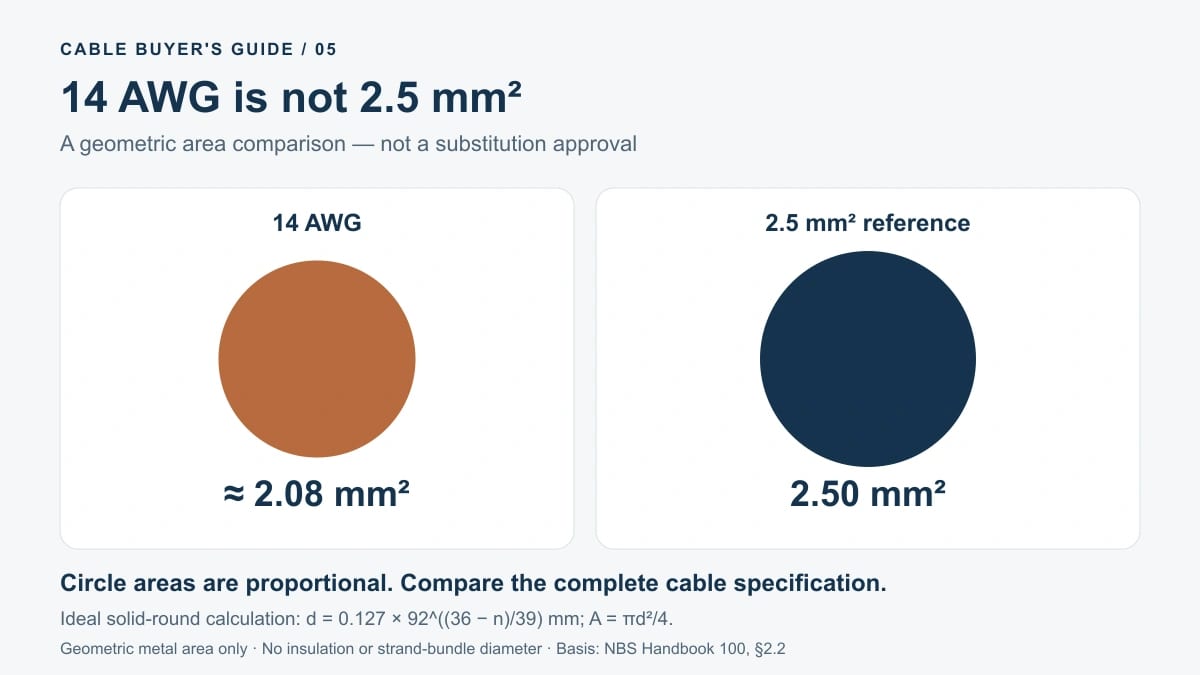
For AWG number n, we calculate d = 0.127 × 92^((36 − n)/39) mm, then A = πd²/4. These values use the ideal geometric progression before rounding; published standard tables may round intermediate dimensions differently. The basis is explained in the NBS Copper Wire Tables, section 2.2.
Do not use the outside diameter of an insulated cable as d. It includes insulation and possibly a sheath, not just the conductor.
A conversion is not a product substitution
A metric nominal size is a specification designation, not a promise that every construction has the diameter of a solid circle with that area. The IEC 60228:2023 public scope includes nominal areas, wire construction and resistance requirements for relevant power-cable and cord conductors. Its applicability depends on the cable product standard; it excludes telecommunications conductors.
For stranded wire, ask for the conductor class or stranding description and the applicable resistance requirement. Do not measure across the complete strand bundle and treat all the enclosed space as metal.
Example: a drawing asks for 2.5 mm² copper, while an offer says “14 AWG equivalent.” The geometric reference is about 2.08 mm². Flag the difference and request the proposed cable's actual designation and evidence for review; a rounded cross-reference is not approval to supply it.
Material also needs its own field. Our copper and CCA guide explains why a size label alone does not establish conductor material.
What do 300/500 V and 450/750 V mean?
For the AC U₀/U notation, U₀ describes the rated RMS voltage between a conductor and earth; U describes it between conductors. Thus:
| Marking U₀/U | Conductor-to-earth rating | Between-conductors rating |
|---|---|---|
| 300/500 V | 300 V AC RMS | 500 V AC RMS |
| 450/750 V | 450 V AC RMS | 750 V AC RMS |
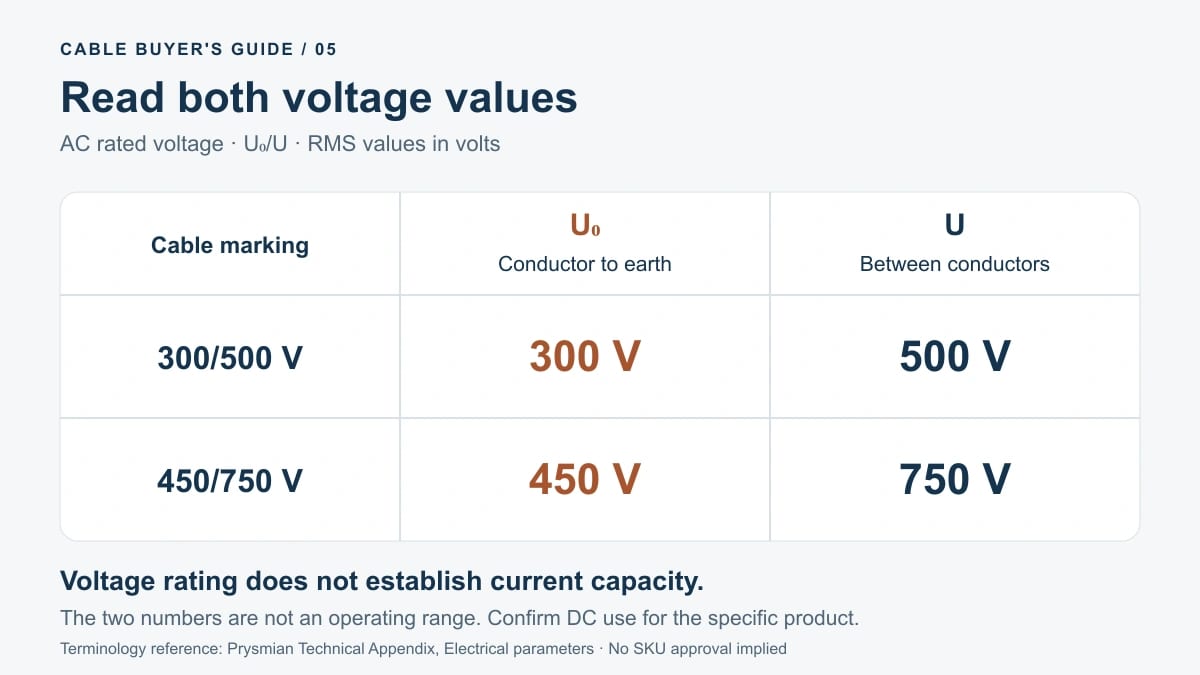
This notation is described in Prysmian's technical appendix, Electrical parameters. The two numbers are not a selectable operating range. A higher voltage marking alone does not establish suitability for a different application. Obtain product-specific confirmation for DC use rather than relabelling an AC rating.
Why this guide does not give a universal amp rating
Current capacity needs a separate assessment of the cable and installation, including temperature and installation conditions. Prysmian discusses current capacity and derating separately from voltage. This conversion table therefore provides no ampacity approval.
For procurement, send the project's load and installation requirements to the responsible technical reviewer and request the applicable product data. If a supplier supplies an amp rating, ask for its reference conditions before comparing it with another offer. A bare number without those conditions is not a complete comparison.
An RFQ example that keeps the requirements clear
The following is an illustrative enquiry template, not a specification for an approved installation:
“Please quote the cable required by the attached drawing, using its stated metric conductor size. Identify the conductor material and construction, core count, complete U₀/U rating, product standard and proposed product code. Provide the matching datasheet and applicable test evidence. List any deviations separately; do not replace the specified size with a rounded AWG equivalent without our written acceptance.”
Add the destination market, intended application, required lengths, packaging preference and quantity. Ask the supplier to confirm availability, minimum order and delivery terms for that enquiry. Those commercial conditions are not established by an AWG table or voltage marking.
Keep the cable's product code consistent across the quotation, drawing and evidence request. For a broader review of what to ask for, see our quality and documentation page.
Frequently asked questions
Is 14 AWG the same as 2.5 mm²?
No. Its ideal solid-round geometric area is approximately 2.08 mm². Treat a commercial cross-reference as a prompt for technical review, not an automatic substitution.
Does mm² mean the diameter of the cable?
No. mm² is an area unit. A finished cable's outside diameter includes other layers and cannot directly identify conductor area.
Does stranded wire have the same outside diameter as solid wire?
Do not assume so. Use the specific construction data; the overall bundle dimension is not the diameter of a solid metal circle.
Does 450/750 V mean the cable can carry more current?
The voltage label does not establish current capacity. Obtain the cable and installation assessment separately.
Does this guide confirm a Sorint Cables SKU's certification?
No. The external references explain terminology and calculations. Request evidence tied to the exact product and intended market; a general guide does not certify a product.
Request a quotation with a clear comparison
Send Sorint Cables your drawing or specification, destination market, conductor material and size, core count, voltage requirement, quantity and packaging preference. Identify any requirement that must remain unchanged and any alternative you want reviewed. Request a cable quotation.
References
- NBS Handbook100 (1966), section2.2: geometric AWG size definition; values here are our own ideal-formula calculation.
- IEC60228:2023 public scope: nominal areas, construction and resistance requirements; telecommunications conductors excluded.
- Prysmian Technical Appendix, Electrical parameters: AC U0/U terminology; no product-specific allowance applied.
- Original editorial area-comparison diagram, approved by owner2026-10-26; geometric metal areas only, not substitution approval.
- Original editorial U0/U typography diagram, approved by owner2026-10-26; no installation plan or product certification.